
Por Stiven Cartagena
August 3, 2026
A Honduran lawyer building a legal startup, an AI-automated aquarium, and a platform that analyzes moles to detect melanoma early. It sounds like a list of startups, but all three projects share something very concrete: they went through USTAAR, the student accelerator program at the University of Miami. And in a city that has spent years selling itself as the natural bridge between the United States and Latin America, that is no minor detail.
Latin America has for decades had one of the lowest investment rates among emerging economies – barely 20% of GDP between 1997 and 2022 – far below comparable countries like Poland or Turkey. Translated to the life of a founder, that means scarce capital, scarce mentorship, and few open doors to enter the world's largest market. That is where cities like Miami come into play.
At the beginning of this year, Miami entered the top 20 global startup ecosystems, according to the business intelligence firm Dealroom. The estimated enterprise value of its companies now exceeds USD$670 billion, and a good part of that momentum comes from its access to foreign markets, starting with Latin America and followed by European countries like Spain.
Miami offers to play an important role in accelerating the growth of venture capital and the startup ecosystem in Latin America by connecting United States resources with opportunities in Latin America and the Caribbean. For an entrepreneur in Bogota, Sao Paulo, or Tegucigalpa, that translates into universities and accelerators functioning as a first stop before trying to scale for real in the United States.
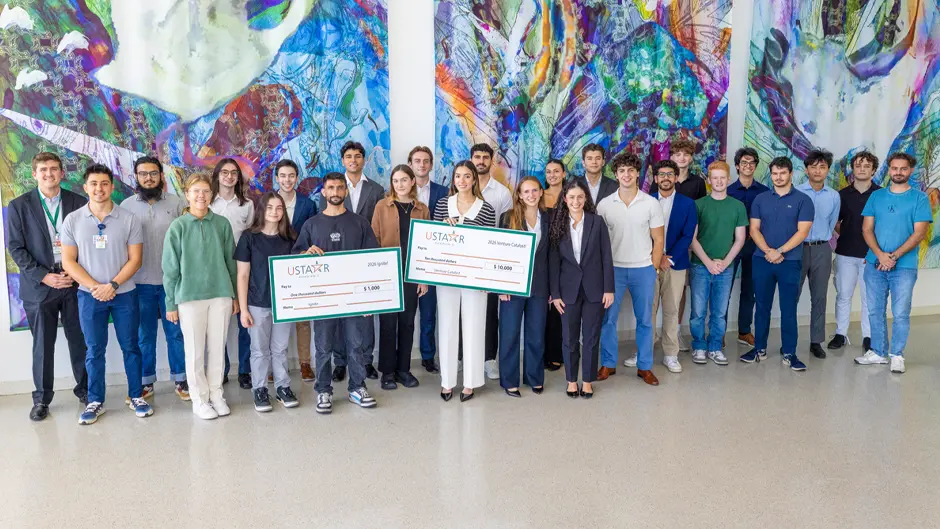
That is where USTAAR comes in, the program led by the Office of the Vice Provost for Research and Scholarship at the University of Miami. It works in two stages. First, founders receive up to USD$10,000 in non-dilutive funding to validate their idea and build a minimum viable product. Later, if the project has already demonstrated traction, they can access up to $100,000 in equity investment to scale.
In April, the program celebrated its third annual pitch competition and distributed $100,000 checks to five startups, achieving 14 equity investments since it started, according to the university's student newspaper. Among the recent winners are Aura Insights, Suisqua, SkinSmart, Textile, and AIdMD.
"As a founder myself, I have gone through many of the difficulties these startups face. That's why we built a program that offers hands-on mentorship, community partnerships, networking opportunities, and seed capital," Suhrud Rajguru, director of USTAAR, told the university's student newspaper.
The program was born in 2024 with a 5 million dollar donation from Ángel Álvarez, a university alumnus and founder of ABB Optical, one of the country's largest distributors of optical products, alongside his brother Víctor Álvarez, a retired corporate finance partner at White & Case LLP. "Our vision is to be a catalyst that allows students to see how they can change the world," Álvarez said when announcing the accelerator.
The case that best summarizes this regional talent flow is that of Reynaldo Pineda, a Honduran lawyer and doctoral student in Juridical Science at the University of Miami School of Law. Pineda founded ULaw, an app that connects people with licensed attorneys to answer specific queries, and today it is part of the USTAAR portfolio while attempting to make its way into the United States legal market.
Last year, he gave a talk to Honduran legal professionals about the challenges of entering that market, where he insisted on something almost every immigrant founder ends up learning the hard way: you have to build connections from scratch, reinvent yourself in an unfamiliar ecosystem, and understand that local rules of the game do not always match international market rules. His story is not isolated. More and more entrepreneurs from the region are arriving at Miami universities looking for exactly that: a foot in the door. Programs like USTAAR end up being their first source of capital and validation.
Other student incubation programs in South Florida have the same goal: the Future Founders Accelerator, from the Launch Pad entrepreneurship center at the University of Miami itself; StartUP FIU, at Florida International University; and Build Up, from the Idea Center at Miami Dade College. USTAAR, for its part, is open to all university students and trainees, seeking to "drive socioeconomic development in South Florida and beyond," says Rajguru, helping to commercialize research coming from biomedicine, engineering, data science, and finance.
In a region where investment remains below that of comparable economies, according to McKinsey, a bridge like the one Miami offers – with capital, mentorship, and access to United States business networks – can be just what separates an idea that stays on paper from one that ends up scaling to the largest market on the planet.

Por Israel Pantaleón
May 6, 2026

Por Stiven Cartagena
March 24, 2026